

A plant-wearable sensor for real-time quantification of transpiration.
Across America’s farm country, one question keeps growers up at night. Are their crops getting the right amount of water and nitrogen? Too little can hurt yields. Too much drains farm budgets, washes into rivers and pollutes wells. Farmers know this balance matters, but finding the “just right” level has always relied on guesswork, experience and weather luck.
A research team at the University of Georgia, Iowa State University and the University of Nebraska at Lincoln, funded by USDA’s National Institute of Food and Agriculture (NIFA), is working to change that. The team is building a new kind of farming tool that combines tiny sensors, simple hardware, software and machine learning. This system listens to plants and soil in real time and gives farmers clear guidance on when and where to irrigate or fertilize.
“When scientists, engineers and producers work together, we get practical tools that strengthen our food supply, protect our water and reduce costs for farmers,” said Dr. Kelly Garbach, NIFA national program leader. “This project shows how real-time data can advance solutions to some of agriculture’s toughest challenges.”
This technology does more than help crops grow. It protects drinking water, reduces greenhouse gases and lowers costs during a time when farmers and families are feeling financial pressure.

Liang Dong
“Our system makes plant needs visible and actionable,” said lead researcher Dr. Liang Dong, Georgia Research Alliance Eminent Scholar and Professor, University of Georgia. “When farmers know exactly what their crops need, they can maintain productivity while using fewer resources.”
Why a Few Extra Pounds of Nitrogen Matter
Most farmers apply more nitrogen fertilizer and water than their crops require. They do this with good reason. Farming is unpredictable, and no one wants to risk losing yield. But the cost of this insurance is high.
Extra nitrogen flows into rivers and fuels algae blooms that threaten ecosystems and drinking water supplies. Extra pumping drains groundwater sources that towns, wildlife and future farms need. Every unnecessary gallon of water or pound of fertilizer also takes a bite out of a farmer’s budget. With heavier rainstorms and hotter summers becoming more common, the stakes keep rising. Fertilizer can wash away during a storm, and crops can experience more heat stress that increases water demand.
The research team wanted to give farmers a new advantage. Their goal was to deliver real-time information from inside the leaf, inside the stalk and inside the soil. With that information, farmers can respond at the right time and in the right place with the right amount.
Sensors That Let Plants ‘Speak’
To achieve this, the team developed a family of miniature sensors, many small enough to fit on a fingertip. Some attach to leaves, some insert into plant stalks, and others stay buried in the soil.
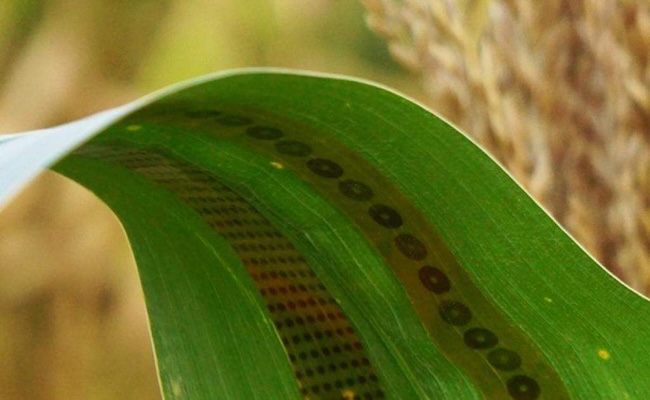
One type is a flexible plant-wearable sensor that looks like a temporary tattoo. It sticks to a leaf and measures humidity, temperature and bioelectric signals. These signals act like vital signs for plants. They show how hard the plant is working to stay cool and how fast it is releasing water through its leaves.
Another type is a microneedle sensor that slips into the stalk. It measures nitrate levels inside the plant. Understanding this flow helps farmers know if crops are using nitrogen efficiently or starting to run low.
Soil sensors look like small matchsticks. They measure soil nitrate levels and soil water tension. This information tells farmers how much water the soil can hold and how easily roots can access moisture. A porous mat helps move tiny amounts of soil water to the sensor surface, which keeps readings steady even during dry weather.
Each device costs only a few dollars to make. A small solar panel recharges the battery, and a low-power radio sends data to a nearby internet-connected gateway. The system sends fresh readings every few minutes. This low-cost design was intentional. Tools built with common materials and open-source code can serve large commercial farms and small family operations.
Turning Measurements into Clear Guidance
Collecting data is useful only when it can be turned into guidance. The team created a digital “brain” that makes sense of everything the sensors observe.
Sensor readings are combined with drone images, satellite data and a proven crop-growth model. Machine-learning software merges these signals into a digital twin. This digital twin mirrors the real field and updates throughout the day.
If the digital twin detects a problem, the system sends an alert. For example, if leaves start to heat up in one corner of a field during a heat wave, it recommends a targeted irrigation pass. If soil nitrate falls below the ideal level in only a few zones of a center-pivot system, the platform suggests adding a light amount of nitrogen just in those areas. Instead of treating the entire field, farmers treat only where support is needed.
Simulations show that this approach can keep yields steady while greatly reducing water and fertilizer use.
In field trials across Iowa and Nebraska, about two-thirds of the leaf sensors delivered usable data for more than two months. They survived strong rainstorms, high winds and intense sunlight. Soil sensors also performed well, even though about one-quarter overheated. That real-world information allowed engineers to redesign the components and add power-saving sleep modes. These improvements increased battery life and helped the sensors remain stable over longer periods.
Results That Reach Far Beyond the Farm
Reducing unnecessary fertilizer and irrigation benefits farms. It also benefits entire communities. These include:
- Cleaner water: Less nitrogen runoff means fewer algae blooms and safer drinking water for rural families.
- Lower greenhouse gases: Applying only the nitrogen that crops need reduces emissions of nitrous oxide, a powerful greenhouse gas.
- Healthier aquifers: Using less water leaves more groundwater available for towns, wildlife and future farmers.
- Lower farm costs: Fertilizer, fuel and water are major expenses. Using them more efficiently protects farmers during difficult weather and uncertain markets.
Dong emphasized these broader impacts. “Water and nitrogen are two of the most expensive and environmentally important inputs farmers use,” he said. “When we help them apply only what is needed, everyone benefits, including growers, consumers and communities downstream.”
Designed for Real-World Use
For technology to be adopted widely, it must be affordable and easy to use. The research team designed the system with these practical needs in mind.
The sensors use inexpensive polymers and common microchips. Replacement parts fit in a glovebox. Data appears on a simple smartphone dashboard. Solar charging keeps the system powered in remote areas.
The platform is designed to support farmers, not replace them. Extension educators in Iowa and Nebraska host field days where growers test the sensors, view live dashboards and explore “what-if” scenarios. Their feedback affects how alerts are displayed so that suggestions match real farm workflows, such as the time it takes to move irrigation equipment or schedule a fertilizer application.
“We replace snapshots with continuous measurements,” Dong said. “When you understand what crops are doing in real time, you can make better decisions for your farm and for the environment.”
Training the Next Generation of Innovators
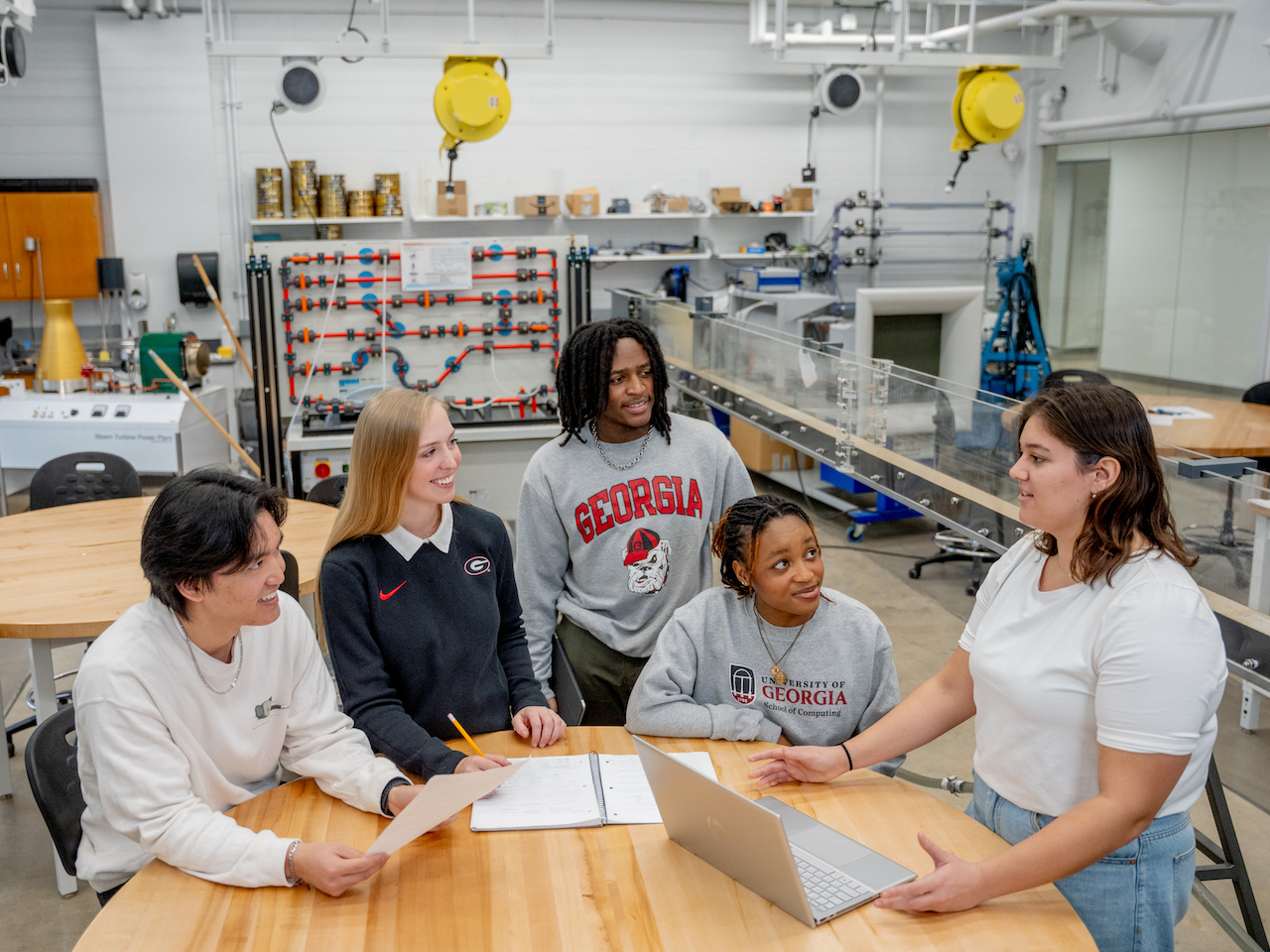
Another important benefit is that it is preparing the next generation of engineers, scientists, and agricultural specialists.
Students helped design circuits, build sensors, install equipment, write software and analyze years of data. Many graduates have since taken jobs in major technology companies and sensor start-ups.
What Comes Next
Researchers expect to test the full system on commercial farms next season. Participating growers will see live maps that show water stress and nutrient levels. They will also receive a record of every recommendation to review at harvest.
The team is improving the sensors by making them more selective for specific nutrient ions and by increasing their durability. They are also exploring partnerships with industry to standardize manufacturing, so the devices become even more rugged, affordable and simple to calibrate. Integrating the system with existing farm equipment will also help support wider adoption.
“By helping growers apply only what their crops need, we safeguard natural resources, support rural economies and build resilience across entire communities,” Garbach said. “That is the power of NIFA-funded public research; its benefits reach far beyond the field.”
This research is funded the USDA NIFA’s Agriculture and Food Research Initiative, the nation’s leading competitive grants program for agricultural sciences.
Writer: Lori Tyler Gula, Senior Public Affairs Specialist, USDA NIFA