

 Multidisciplinary student teams collaborate with industry and community partners to solve real-world challenges
University of Georgia students are making an impact far beyond campus – even before graduation.
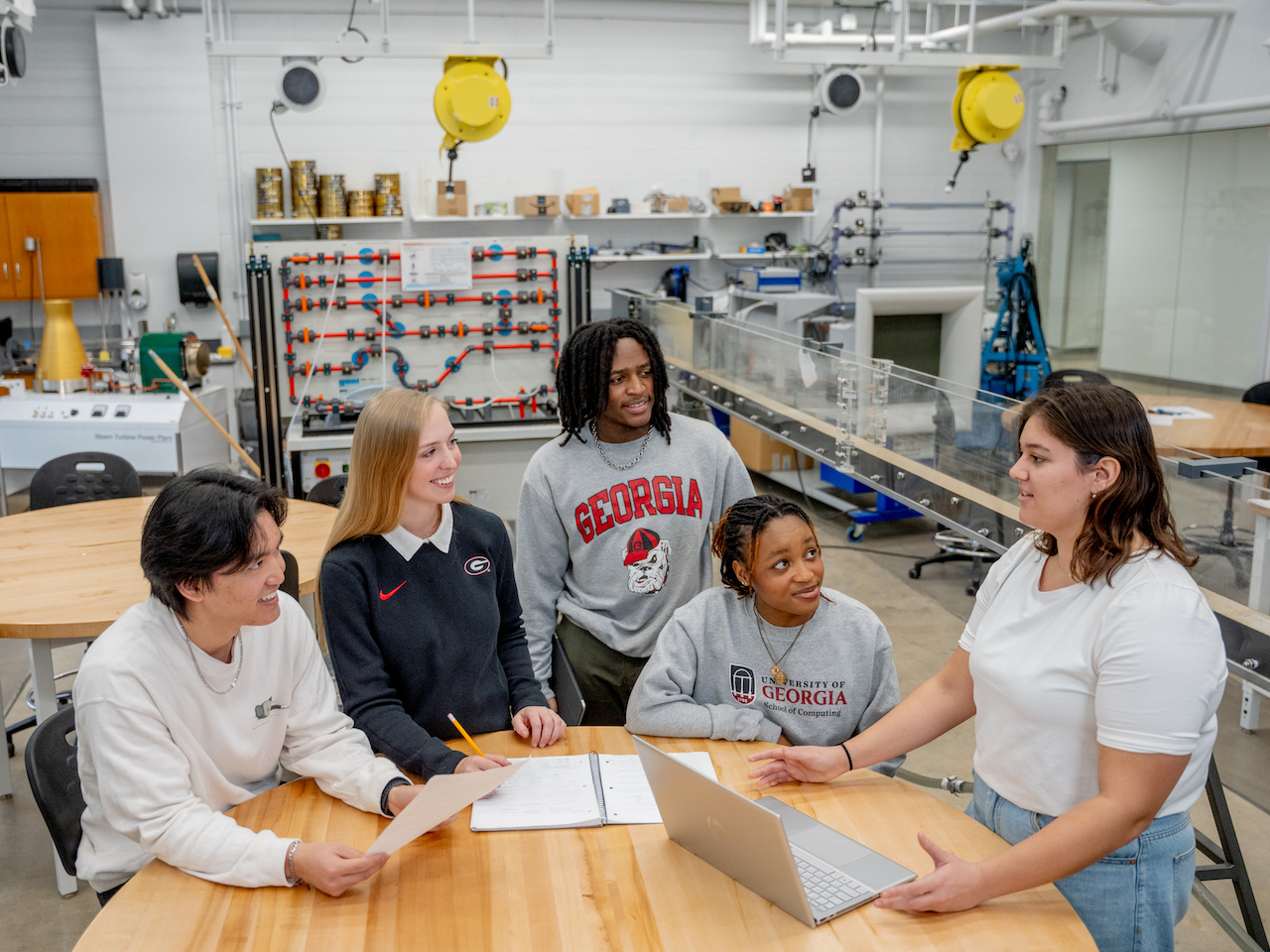
Over the course of an academic year, senior-level engineering and computing students work together with business, industry, nonprofit, and community partners to address real-world problems.
“What makes our capstone design program so unique is our ability to couple technical preparation with professional development,” said College of Engineering interim dean Stephan Durham. “This is an opportunity for our students to audition – to navigate the inherent challenges of working on a multi-disciplinary team and completing a real-world design project for a company or community prior to graduation.”
Students lead engineering design projects from planning to completion. While benefiting the client, students develop essential leadership and professional skills required of them when entering the workforce, including creative problem solving and cooperative collaboration. The ethics, laws, rules and regulations, licensure, leadership, and professional practice of engineering are also important aspects threaded throughout this course.
“The Capstone Design Program is by far the most comprehensive learning experience I’ve had at the University of Georgia,” said senior computer systems engineering student Nate Guenard, who worked with Kubota Manufacturing of America under the direction of assistant professor Roger Hilten to develop a solution to a problem in the assembly process of one of their products.
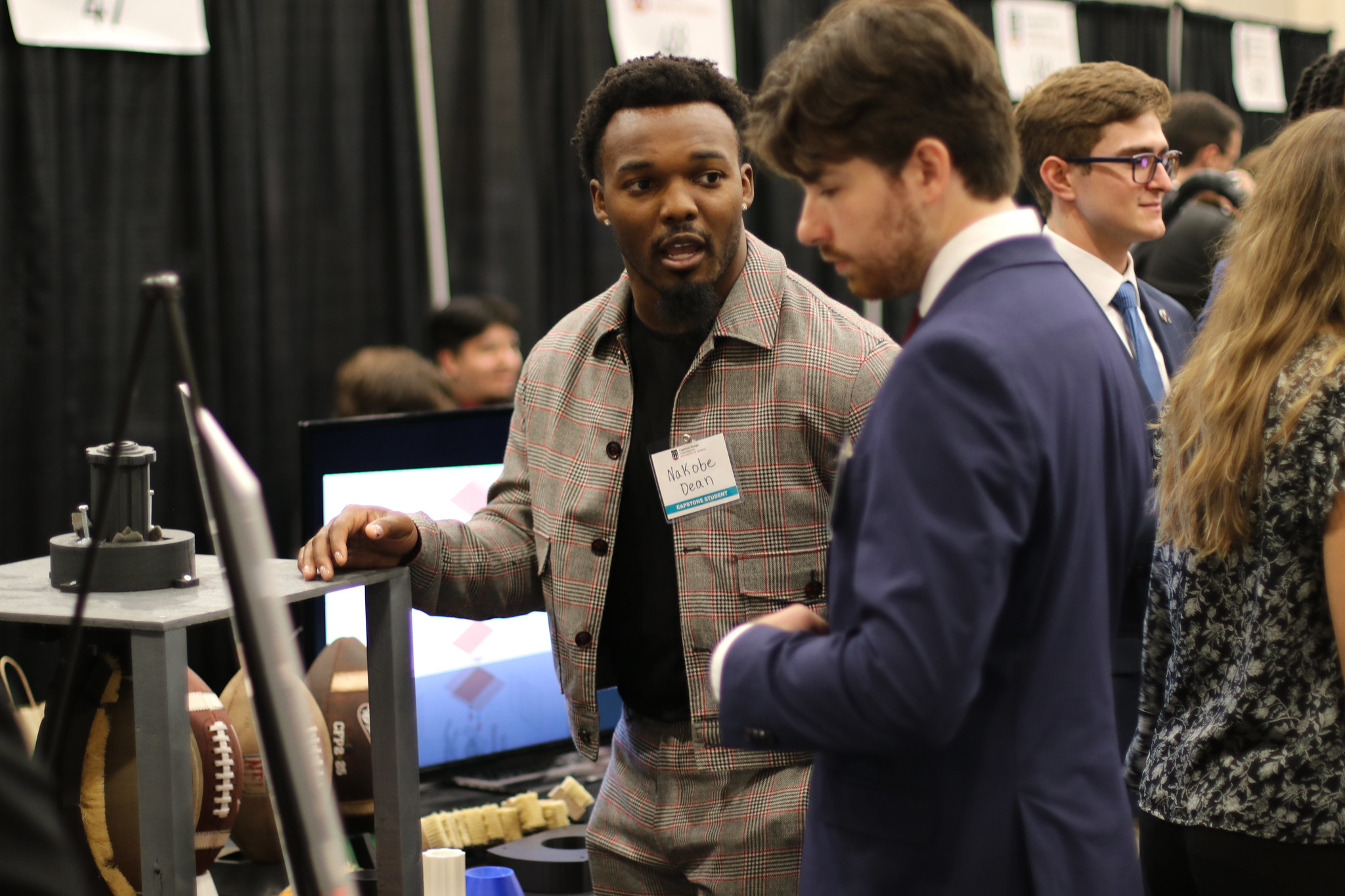
Capstone student Nakobe Dean showcases his project, “Football Mud Remover Device (FMRD).”
Each student team consists of three to five members across different majors in the College of Engineering, with the goal of providing students insight into working with various disciplines. Projects address a wide range of design needs, from infrastructure to software, machines to manufactured systems, medical devices to sustainable solutions.
“My interdisciplinary team of three mechanical engineering students and one other computer systems engineering student has gained invaluable hands-on experience, employing real-world industry standards, project management strategies, and design methodologies,” Guenard continued. “This project has touched countless areas of engineering and introduced me to working in industry.”
A unique aspect of the capstone design program is the integration of the Emerging Engineers Leadership Development (EELD) program. Through interactive modules led by the J.W. Fanning Institute for Leadership Development, students cultivate essential skills in communication, leadership styles, making group decisions, conflict management, entrepreneurial thinking, and more to help them in preparing to complete their projects and enter their professional careers.
Partners make the program possible
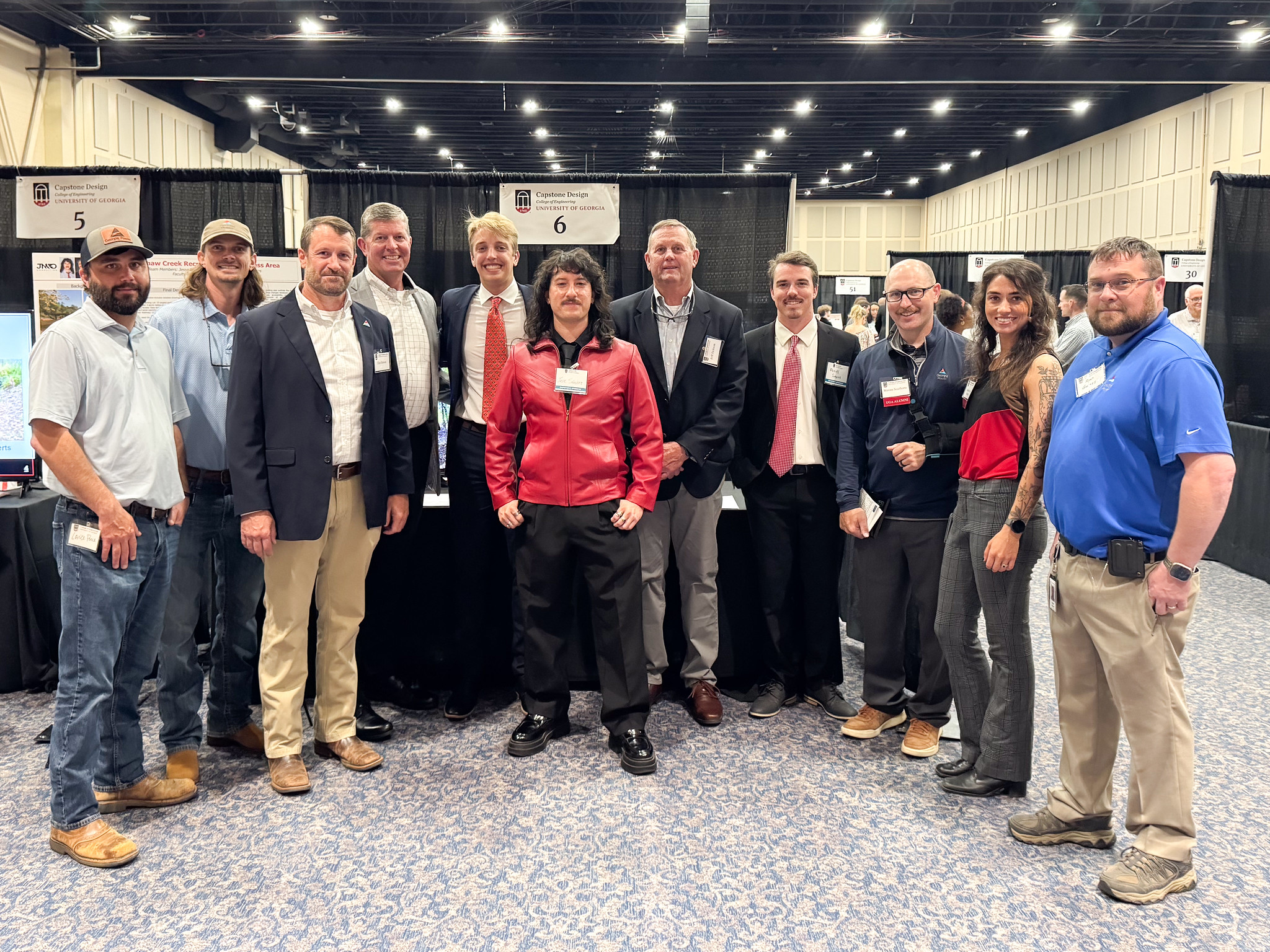
Representatives from Georgia Power pose with one of their sponsored capstone groups, “Design a New Recreation Public Access Area (Lake Jackson/Tussahaw Creek).”
Throughout the project cycle, teams receive guidance from an appointed faculty project supervisor and a designated point of contact within the partner organization. On average, over 50 partners from various sectors work with the program each year, with over 30 college faculty members involved in both instruction and project supervision.
“Capstone has provided me with an opportunity to explore coastal engineering under the guidance of some of the most respected professional engineers in the field,” said senior environmental engineering student Katie Kahn, who worked with AtkinsRealis, Inc. under the direction of assistant professor Matthew Bilskie to design a resilient shoreline protection solution to mitigate damage and enhance long-term coastal resilience in the Summer Haven area in St. Johns County, Florida. The area faces severe coastal erosion and rising sea levels, threatening homes and infrastructure along Old A1A.
“This experience has been the highlight of my undergraduate education, and has inspired my master’s research,” Kahn continued. “I have gained deep insight into protective design considerations, sheet set conventions, and the client-engineer interface.”
The relationship between the project partner and project team is mutually beneficial. From large corporations and government entities to startups and entrepreneurs, every client has different needs. To meet those individual needs, the college tailors the experience to each client, while providing students with a unique educational experience that bridges academia with industry.
“I’ve been working with UGA students for over eight years now – getting to see them grow as they develop their tools of the trade, learn a little bit about our industry, and enter into the workforce,” said Georgia Power Company distribution manager Steven Scarboro (BSAE ’03).
“From a Georgia Power perspective, we believe in being a citizen wherever we serve. We believe in spending time in our communities, engaging with the schools, and getting to spend time helping students learn about our industry,” Scarboro added. “It really benefits us to be able to foster that community involvement, learn about the students individually, and help them grow to be a product of the future workforce.”
Showcasing the solutions
The course culminates in the annual Capstone Design Showcase, where students display the prototypes, designs, and solutions developed for their projects to clients, faculty, and the community.

A student takes the “Autonomous Driving Simulator with Logitech Racing Wheel and Pedals Set” project for a spin.
The 2025 showcase, held on April 23 at the Classic Center in Athens, featured the innovative designs of 114 multidisciplinary student teams.
During the event, projects are evaluated by a judging team of engineering professionals in both industry and academia, based on criteria aligned with the learning outcomes outlined by ABET. Awards are given for the best projects in the categories of “Community Impact,” “Computerized System or Software Design,” “Machine Design,” “Manufactured System or Process Design,” “Medical Device or Biological Process Design,” and “Sustainable Design.”
In addition to the project awards, recognition is also given to one “Outstanding Capstone Partner” and one “Outstanding Project Supervisor,” presented this year to Georgia Power and Sidney Thompson, respectively.
This year’s showcase was presented by Becton Dickinson and Gulfstream.
Building for the future
As the College of Engineering continues to grow, so does the demand for Capstone Design projects.
Each year, companies and communities are invited to submit project proposals to develop, improve, or enhance processes and designs within their organization. In addition, sponsorship opportunities are available to support project materials, leadership development certification, project supervision, software, tools, and other resources to ensure students reach the best outcomes for their clients.
Capstone design program participation and sponsorship has been used by many companies and organizations to recruit talented graduates from the University. Contributions from sponsors allow the college to continuously make enhancements to improve the student and client experience, while eliminating financial barriers that could potentially hinder successful project outcomes.
To learn more about UGA College of Engineering Capstone Design or submit a project, visit the program’s website.
Writer: Lillian Ballance, [email protected]